Strategy Rules: Five Timeless Lessons from Bill Gates, Andy Grove, and Steve Jobs by David B. Yoffie & Michael A. Cusumano
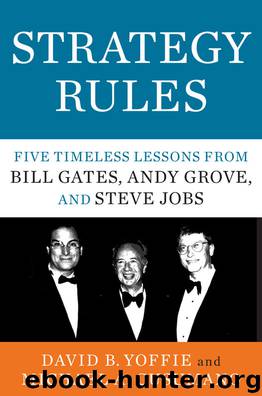
Author:David B. Yoffie & Michael A. Cusumano [Yoffie, David B.]
Language: eng
Format: epub, mobi
Publisher: HarperCollins
Published: 2015-04-14T06:00:00+00:00
CHAPTER 4
Exploit Leverage and Power—Play Judo and Sumo
Thinking strategically is the fun part of business. Great strategists think big thoughts about the purpose of their enterprises, the long-run visions for their firms, the big bets they plan to make, and the products, platforms, and ecosystems they hope to build. But it is not enough to think big thoughts. To become a great strategist, you must turn your vision and high-level ideas into tactics, actions, and organizations that reach the customer and fend off the competition. In this chapter, we explore the tactical link between thinking strategically and delivering real outcomes; in the next, we talk about building organizations that embody the distinctive competitive edge of the leader.
Arthur Rock, one of Silicon Valley’s most famous venture capitalists and an early investor in both Intel and Apple, once wrote, “[S]trategy is easy, but tactics—the day-to-day and month-to-month decisions required to manage a business—are hard.”1 Some CEOs may be tempted to delegate this hard work to subordinates, but not Bill Gates, Andy Grove, and Steve Jobs. All three were intimately involved in day-to-day tactical decisions as well as longer-term strategy. Gates loved to go deep into the software code and challenge his engineers at the algorithm level, at least through the early 1990s. Grove liked to feel the weekly pulse of sales numbers and marketing campaigns as well as closely track the financial impact of manufacturing capacity decisions. And Jobs was famous for getting into the nitty-gritty of product design and marketing.
At the same time, all three were known for their “take-no-prisoners” style. Behind the facades of the geek, the engineer, and the aesthete, Gates, Grove, and Jobs were fierce competitors who sought to win at almost any cost. They showed little hesitation when it came to undercutting rivals, squeezing partners, or keeping errant customers in line. They led start-ups that grew into large, powerful companies, and they skillfully wielded their market power to stay on top. As a result, they were often tagged in the press—and sometimes by regulators—as bullies or worse.
But all three CEOs were more subtle tacticians than their public images suggest. While famous for maneuvers that relied on their companies’ power and size—such as “buy or bury the competition,” in Jack Welch’s words2—they often employed tactics that put a premium on smarts, not strength. Throughout their tenures, Gates, Grove, and Jobs drew on an extensive repertoire of moves, picking and choosing depending on the situation they faced. Some of these choices may seem surprising, such as the “puppy dog ploy,” which we describe below. Sometimes leaders of large, successful companies overlook such tactics or write them off as makeshift maneuvers they resorted to on their way up—and have now left behind. But Gates, Grove, and Jobs showed unusual flexibility in their approach to competition, freely adopting tactics more commonly associated with small, vulnerable start-ups as well as others that made full use of their strength.
In other words, all three proved to be masters of what we have previously called tactical judo and sumo.
Download
Strategy Rules: Five Timeless Lessons from Bill Gates, Andy Grove, and Steve Jobs by David B. Yoffie & Michael A. Cusumano.mobi
This site does not store any files on its server. We only index and link to content provided by other sites. Please contact the content providers to delete copyright contents if any and email us, we'll remove relevant links or contents immediately.
Hit Refresh by Satya Nadella(9111)
The Compound Effect by Darren Hardy(8913)
Change Your Questions, Change Your Life by Marilee Adams(7725)
Nudge - Improving Decisions about Health, Wealth, and Happiness by Thaler Sunstein(7684)
The Black Swan by Nassim Nicholas Taleb(7095)
Deep Work by Cal Newport(7050)
Rich Dad Poor Dad by Robert T. Kiyosaki(6584)
Daring Greatly by Brene Brown(6494)
Principles: Life and Work by Ray Dalio(6393)
Playing to Win_ How Strategy Really Works by A.G. Lafley & Roger L. Martin(6195)
Man-made Catastrophes and Risk Information Concealment by Dmitry Chernov & Didier Sornette(5990)
Digital Minimalism by Cal Newport;(5743)
Big Magic: Creative Living Beyond Fear by Elizabeth Gilbert(5731)
The Myth of the Strong Leader by Archie Brown(5484)
The Slight Edge by Jeff Olson(5401)
Discipline Equals Freedom by Jocko Willink(5365)
The Motivation Myth by Jeff Haden(5196)
The Laws of Human Nature by Robert Greene(5145)
Stone's Rules by Roger Stone(5070)
